


The MET Journal

Research Reports

Profiles

Issues Unraveled

Critical Analysis

Observer

Apr 2nd - 2 Min Read

Syria, a battle field of Iran & US

Syria

On Friday morning, US launched a significant aerial attack in response to a suicide drone assault that resulted in the death of a US contractor and the injury of multiple service members at an American base located in northeastern Syria, Rojava. It seems that the US responded with additional retaliatory strikes on Friday, after a second assault by militias under Iranian control. It is uncertain whether these strikes involved missiles or were conducted through the air. The US Central Command released a statement stating that coalition forces were targeted by ten rockets at around 8:05 am local time on Friday. In the meantime, the targeted forces declared in an online statement on Friday evening that they have the capability to respond to any further US attacks on their positions, following reciprocal strikes in Syria during the past 24 hours.


After the first assault, Defense Secretary Lloyd Austin stated that US Central Command troops launched "precision airstrikes" against installations in eastern Syria used by factions associated with Iran's Revolutionary Guard. The Defense Department disclosed that the intelligence community verified that the unmanned aerial vehicle used in the attack was manufactured in Iran. According to the Pentagon, two of the American service members injured in Thursday's assault received treatment at the location, while the contractor and three other service members were taken to medical facilities in Iraq. President Biden offered his condolences to the families of the affected individuals during a trip to Canada on Friday and stated that the US would not hesitate to respond to any Iranian aggression. He also stated that, “the US ‘does not seek conflict with Iran’ but would respond ‘forcefully’ to attacks on US forces in Syria”


According to Col. Joe Buccino, a spokesperson for CENTCOM, launching rockets without discrimination puts not only American troops and coalition forces in danger, but also endangers Syrian civilians and threatens the security and stability of the entire region, adding that  they will do everything necessary to protect their personnel and retaliate when and where needed. During his testimony before Congress, Kurilla stated that Iran's military capability has increased exponentially in recent years, with the region's largest drone and missile force. According to Kurilla, Iran uses Iranian proxies to launch attacks against American forces in Iraq or Syria, in an attempt to conceal their involvement


By: S.R

Mar 30th - 2 Min Read

Swaying Popularity in Turkish Elections Using Music

By: Birhat Atrushi

Election campaigns can be various forms of efforts to bring a certain political figure’s decisions fourth for the public. Be it slogans, conferences, speeches, rallies, the world’s democratic states are all familiar with these periods. In fact, it is very important for a politician to familiarize their political platform and plans for their citizens.


But in the depth of such a massive and time-draining attempt to communicate with the people, the particular methods which they use to each of the groups of a country is wildly different. A politician perhaps will speak of ideology and legal and political plans for a university and he may also bring efforts to solve various economic problems for companies, but for a whole, art has always been a key factor in coloring this message.


Turkey’s upcoming elections of 2023 is a massive event. Both internal and external observers brace tight for the results that will shape not just the political landscape of Turkey, but of years of international diplomacy and foreign policies. Thus, when a political figure, be it right, left, center, funds various artists and groups to, for instance, compose musical campaigns, it is no wonder how influential it might be.


To speak directly to an audience is a very major task and to captivate them with forms that they partake in is a guaranteed win. So for every political figure, there seems to be a theme song. And no, it's not some effortless advertisement.


In fact, music and politics go hand in hand even before modern electoral history in Turkey, when the Ottoman Empire produced military bands for the first time in the region and brought various instrumental pieces, music has always been a landmark need for political messages to have an aesthetic foundation.


So the next time anyone is running for office, they sure will deploy a musical piece for themselves.


More...

Mar 28th - 2 Min Read

A Harvard study of 85-Year Divulges the Secret of Happiness and Living Longer

Self-development
By: Ayat Abdulhameed

Being happy and aware of that feeling reduces the risk of heart disease, stroke, and decreases lung capacity and function. It is also associated with a lower risk of early death from cancer and infection. To put it straightforwardly, being happy helps us live longer. But what actually makes us happy?


An 85-year Harvard study answered that. In 1938, Harvard researchers undertook a decades-long research to find out the key to a happy life. This research gathered health records from  724 participants around the world and set detailed questionnaires about their lives at two-year gaps. You might think it is career achievement, wealth, exercise, or a healthy diet. Well, the most constant finding through these 85 years of study is: positive elationships keep us happier, and healthier, and help us live longer.


One way to achieve a positive relationship is ‘Social Fitness’. Believe it or not, relationships affect us physically,from that invigoration when you feel like someone has really understood you during a good conversation or that stomachache when you find out your romantic partner cheated on you. One way to have a healthy and balanced relationship is “Social Fitness.”


Our social life is a living system and establishing relationships alone doesn't mean they will be healthy. Social fitness requires investing in our relationships and being honest with ourselves about where we are devoting our time and if we are tending to the connections that help us thrive.


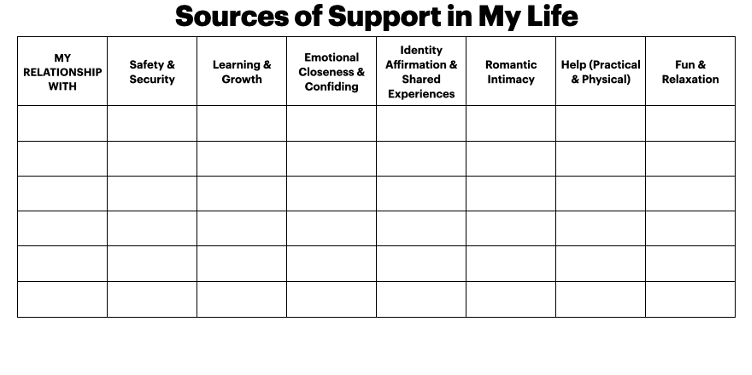
There are seven keystones questions to ask yourself in order to understand your relationships:


1- Safety and security: who do you turn to in a moment of crisis?

2-Learning and growth: who encourages you to take chances and pursue life’s goals?

3-Emotional confiding: who knows most of the things if not everything about you?

4-Identity affirmation and shared experience: who do you have the most shared experiences with? And who strengthens your sense of who you are?

5-Romanic intimacy: do you feel satisfied with the amount of romantic intimacy in your life?

6-Help: who do you turn to if you need help or expertise in solving practical problems?

7-Fun and relaxation: who makes you laugh? Who do you call when you want to do a fun activity?


Below is a table arranged around the seven keystones, the first column is for the relationships, place a plus (+) symbol in the columns if a relationship seems to add that type of support in your life, and a minus (-) symbol if a relationship lacks that type of support.


Think of this exercise as an X-ray tool that will help you see below the surface of your social universe. The gaps on the chart might make you realize that you have plenty of friends, but no one to confide with. And show you who to really trust and invest in. Don't be afraid to reach out to the people in your life, it's never too late to deepen the connections and find someone who you might feel all of these with.


More...

Mar 27th - 2 Min Read

Exploring the Advantages and Potential Health Effects of 5G Internet

Technology
By: Herish Badal

The internet has changed business, healthcare, education, government, and many ways humans communicate. The internet has a high-impact in breaking down communication barriers.We can interact with almost everyone at any instant. Moreover, we can now interact with  objects such as robots, vehicles, smart houses, among others . The internet is continuously evolving to meet the demands  of a faster and more capable network. The internet has generations of different technologies aiming to provide higher speeds,  increased reliability, better availability, and more capable data transmission. Therefore, they developed a 5G internet network that many countries, including some Middle Eastern countries, are excited about and want to welcome.


5G is the 5th generation mobile network. It is a new wireless communication standard after 1G,2G,3G, and 4G networks. 5G was developed by telecom and cellular phone companies in 2019, to connect everyone with everything virtually like never before, but it is still under process and research. South Korea, China, and the United States are the countries that lead the world in building and deploying 5G technology. While 5G is still under further development, 6G internet is being researched simultaneously.


5G uses high-frequency radio waves called Millimeter Waves that have a shorter range than the frequencies used by typical cell phone towers. This new technology cannot use a single tower inside a cell( a cell is a geographical area covered by a single internet tower ). Instead, it uses microcells with many smaller antennae inside them in neighborhoods. 5G signals may encounter challenges in penetrating buildings and covering large areas because it uses high-frequency waves. Thus, to be available to all users, it needs to have many antennas in the neighborhood.


Speed makes 5G different from other internet generations.5G wireless technology is designed to deliver peak data up to 20 Gbs based on IMT-2020 requirements. This means that 5G is almost 20 times faster than 4G LTE, which will transform so many areas of life. For instance, 5G will be essential in education, autonomous vehicle technology, healthcare, revolutionizing farming, smart houses, and IoT. 5G availability in hospitals and medical offices worldwide could transform healthcare enormously. Doctors and health specialists can quickly transmit large imaging files to each other so patients can get results and reviews quicker. Moreover, they do surgeries remotely from their offices regardless of the patient's location. For Instance, China has already completed the first 5G remote surgery in a test on animals.


Having these antennas transmitting high-frequency waves all around, which create electromagnetic radiation, has made people concerned about health risks. For instance, in 2020, almost 80 mobile towers were burned in the UK due to coronavirus conspiracies. Many people think 5G might cause health issues in the future, but according to the WHO, "To date, and after much research performed, no adverse health effects have been casually linked with exposure to wireless technologies. So far, only a few studies have been carried out at the frequencies to be used by 5G." We should not be worried about 5G, but we would have to wait long enough to see the consequences of 5G. According to WHO, "There is less penetration into the body tissues, and absorption of the energy becomes more confined to the surface of the body (skin and eye). Provided that the overall exposure remains below international guidelines, no consequences for public health are anticipated." WHO and International Agency for Research on Cancer ( IARC) have mentioned that radiofrequency radiation is possibly carcinogenic. This study shows adverse health risks of 5G on human health, So should you still be worried about 5G? That depends on how much you trust WHO and other organizations that study such matters.


Gulf Cooperation Council (GCC) countries, including Qatar, UAE, Bahrain, Kuwait, and Saudi Arabia, have been the forerunner in rolling out 5G networks in the Middle East region during 2019. While Oman, Lebanon, Egypt, and Turkey aim to adopt and implement 5G network service in the near future. Iraq has recently permitted telecommunication companies to provide 4G LTE service after being scrutinized for several years due to political and economic challenges, the Kurdish region on the other hand, has been able to provide 4G LTE and 4.5 G LTE, primarily through services offered by Fastlink, Korek, and other internet service providers.


More...

Mar 19th - 2 Min Read

Iran and Saudi Arabia, Old Foes and New Friends

By: SeyedehZhina

Developments can happen rapidly in the Middle East, as evidenced by recent events. Despite rumors that Israel and Saudi Arabia were moving closer, Iran and Saudi Arabia have agreed to restore diplomatic relations. The warming relations between Israel and various Gulf countries have largely been due to their shared hostility towards Iran. After a seven-year break in ties, Iran and Saudi Arabia have agreed to reopen embassies in each other's capitals within two months.


This agreement was reached in Beijing and brokered by China,  to mend relations between Saudi Arabia and Iran, which suggests  a temporary rearrangement of the alliances and rivalries, sidelining the involvement of Washington. The United States, has been the main player in the Middle East for the past 75 years and usually present during important events, now observes from the sidelines during a time of significant shifts. Meanwhile, China, previously played a minor role in the region, has become an active player. Israel, aligning with Saudi Arabia against Iran, is now uncertain about its position in light of the recent changes.


State media in Iran has shared pictures and videos of Ali Shamkhani, the Secretary of Iran's Supreme National Security Council, along with Saudi National Security Adviser Musaad bin Mohammed al-Aiban and China's senior diplomat Wang Yi. According to Iranian state TV, the foreign ministers of the two countries will meet to prepare for the exchange of ambassadors . Wang congratulated both sides on their "wisdom" and said that China fully supports the agreement, adding that both countries had shown sincerity. According to the statement, Riyadh, Tehran, and Beijing expressed their eagerness to work together to improve global and regional peace and security. Ali Shamkhani, secretary of the Supreme National Security Council of Iran, reportedly described the discussions in Beijing as transparent, comprehensive, and constructive, and emphasized that reducing misunderstandings between Tehran and Riyadh will improve regional stability and security while fostering greater cooperation between the Persian Gulf nations and the wider Islamic world in dealing with the present challenges.


More...

Mar 19th - 1 Min Read

Turkish Earthquake Regulations and Amnesties

By: Danar Rebar Khorsheed


The recent earthquakes that hit Turkey collapsed a large number of buildings including the newest ones and many lives were lost, this incident has raised questions by many entities and sparked anger, including BBC which started an investigation into some buildings and the construction companies that executed the projects.


Turkey developed “earthquake regulations” in the last semi-century as its geography is not immune to earthquakes. However, these regulations require constant updates. This process began in the 1960s and the most recent update on these regulations was in 2018. On the other hand, it has developed amnesties in the form of paying a fee as a legal exemption which has helped many construction companies to take advantage. Turkish critics have warned that these amnesties will cause major catastrophes in the future in case a strong earthquake occurred.


Pelin Pınar Giritlioğlu, Istanbul head of the Union of Chambers of Turkish Engineers and Architects' Chamber of City Planners, stated that up to 75,000 buildings across the affected earthquake zone in southern Turkey have been given construction amnesties.


Just days before the earthquakes, Turkish media reported that a new draft law awaits parliamentary approval that would give amnesty for recent construction projects, which was acknowledged by a geologist as a crime.


This shows that Turkish construction companies did not follow these regulations as required and did not use quality materials, in addition to taking advantage of the amnesties that saved them an effort and made financial gains for the government.


More...